Sixpenny Handley, Dorset, England.
Sixpenny Handley is a quiet village situated on Cranborne Chase just inside the county of Dorset. After a great fire in 1892 destroyed most of the village, so much help was sent in the form of clothing for the resulting homeless that it could be said a man could be identified as being from Sixpenny Handley because he wore two or even three waistcoats.
Now I like a good tale, and I like a good quirky village name, and I equally like a waistcoat of jazzy colour, but it wasn’t the prospect of walking around wearing multiple layers that was drawing me to Sixpenny Handley, it was something slightly less remarkable, a barn in a field. It was the start of a seven-day photography trip to Dorset and Devon in July 2020. This was my first trip out of the pandemic, where up until now I had been keeping myself sane taking pictures of every flower in the garden. My first day involved a 250-mile overnight drive through Salisbury, bypassing Stone Henge, to find an elongated kite shaped field just outside the village of Sixpenny Handley. In that field stands an old Dutch barn. The weather forecast was good, with clear skies, sunshine and little wind. I wanted to be there for sunrise and was praying for a little bit of atmosphere thrown in. The temperature overnight had dropped after a day of rain, so I had one thing on my mind and that was MIST. Actually, I had more than one thing on my mind as I found myself bumping along country lanes in the dark. My other thought was about freedom, and how we had all been deprived of this for so long. Trapped in our homes, with one walk a day at best was awful for all of us. Now I was out in my van (Mr T), heading to the other end of the country for a week of fresh air and hopefully some great locations.
“It was a deep grunting bark, and it came from the middle of the field”
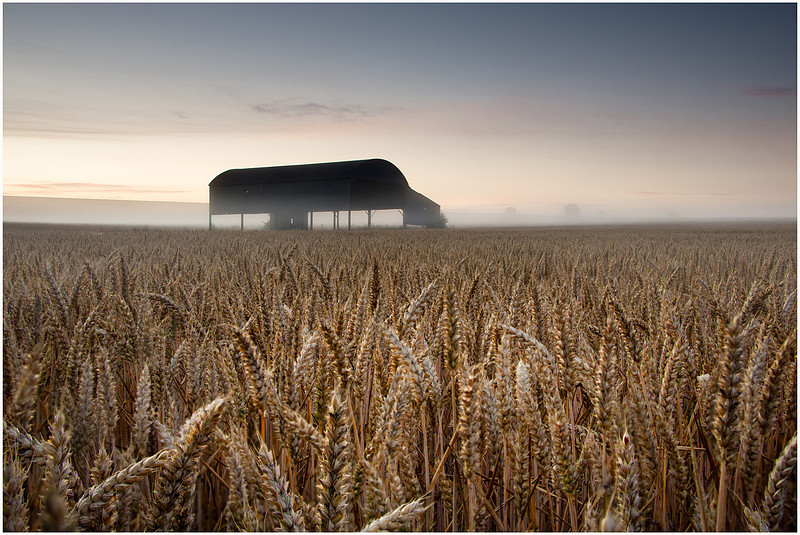
Just after 3am I arrived in a small layby near the barn and headed straight down the road, guided by my head torch to find the best spot for the sunrise. My wishes had come true, and I could see some mist forming in the field as I shone my head torch over the hedge. I followed the road finding gaps in the hedge where I could point my camera at the barn. Let’s not forget this is a farmer’s field with a crop of wheat on its way to be harvested very soon, the last thing they need is me tramping through damaging the crops, so I was staying outside the hedge looking in. But I could get my tripod over the hedge and get close to the wheat. As the glow of the rising sun started to fill the field, the mist was forming on the far side. Perfect. Time to grab my first image of the day, my first image out of lockdown, my first image of freedom.
Fields of wheat at Sixpenny Handley
I wanted to get closer, and when walking down the road I had noticed a gate into the field with some tracks in the crop where I assumed the wheels of the farmer’s vehicles had been. These looked like some great leading lines into the barn itself. I was packing up my camera to go back to this spot when I heard it. It was like a bark. It was a deep grunting bark, and it came from the middle of the field. I looked over to the right of the barn and there in the distance were a pair of antlers emerging from the wheat. A glorious pair of antlers twisting and flicking as a deer moved through the crop. Then he raised his head and let out another bark. Too far away to see, but I imagined seeing its breath in the cold misty air as he barked a warning. I had been spotted, and whilst I scrambled to get my camera back out of the bag, he turned and gracefully leapt through the crops away from me and into the distance. What a privilege, what a sight. One minute earlier and it would have been in my frame. To quote a famous politician, “Them’s the breaks”.
“I just couldn’t seem to focus”
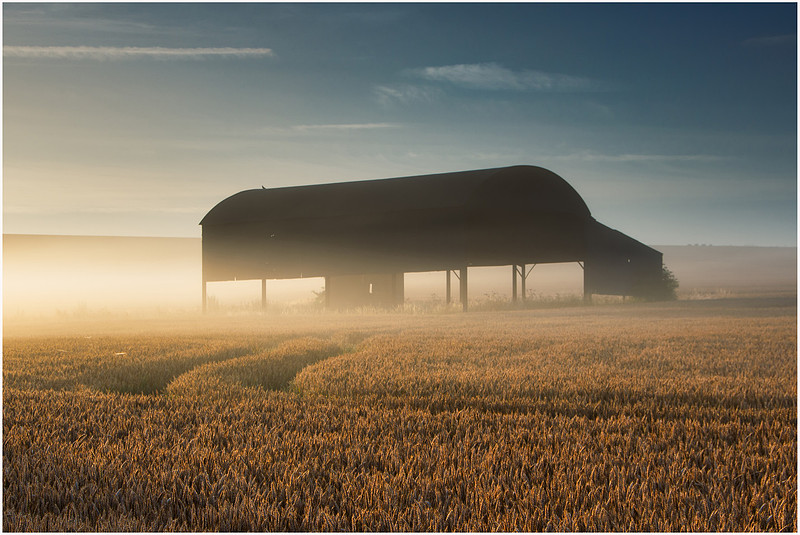
The sun was threatening to break the horizon very soon so I quickly repositioned myself back up the road where I could be a little higher and zoom in on the barn. The vehicle tracks were creating a small s-curve in front of the barn giving me a nice leading line. The mist had also rolled closer to me and it was all coming together. I had a few minutes until sunrise so set about getting my composition right and taking a few test shots. I swapped over from my wide angle to my 18-200mm zoom so I could get more of my subject in the frame. But, something wasn’t quite right, I just couldn’t seem to focus. I use what is known as ‘back button focussing’ which is where I have switched off auto focus on the shutter button so autofocus can only be activated from a button on the back of the camera. This way, I can set the focus in my image and take as many shots as I like without it trying to refocus on each press of the shutter. Each time I pressed the focus button the lens hunted for focus out then on the way back would grind and stop. I went to grab the focus manually using the lens ring and I felt the unmistakable grind in the mechanism. Sand! It could only be sand or grit had gotten into the mechanism of this lens. This was a challenge, but I had to work through it and push the lens focus ring through the grind and get the focus. I only had a minute or so before sunrise and no time to change lens and reset my composition. I set my aperture to f/8 to give me a reasonable depth of field and managed to get focus on the barn with the help of a bird that landed on the roof. The sun broke the horizon to my left and lit up the mist in the field turning everything gold.
Golden sunrise at the Dutch Barn.
There was no noise, the road behind me was silent. All I could hear was the occasional chirp of the small birds in the hedgerows. I took it all in and enjoyed the moment grabbing several images. I wasn’t the only one, clearly the bird on the barn was also enjoying the sunrise and had a great viewpoint. I flipped my camera to portrait to capture a great little cloud that was above me and got some more of the golden light and shadows on the wheat in front of me.
Dawn colours across Sixpenny Handley.
What a great moment to have experienced as my first morning away from home after the pandemic. All those hours, days, weeks and months we had all been forced to stay home and stay safe, my first real trip away had given me this moment. Seeing the solitary deer in the mist made it all the more special. Did you know Reindeers are the only species of deer where the females grow antlers? Whilst the males grow their antlers for fighting in the rutting season, the females grow theirs for finding food in the snow. This means the males shed their antlers in Autumn after the rut, but females keep theirs until spring. So, was Rudoph actually a girl given he/she was pulling the sled for Santa in December? Well no, as most of the reindeer used to pull sleds are castrated males as they are easier to handle, and therefore have antler cycles similar to those of the females. There you go! Poor Rudolph, I‘m not surprised his nose was glowing. Just under nine miles away was my second location for the morning, and the combination of mist and clear sunrise was going to be perfect. As much as I wanted to just stay and soak up this atmosphere, I needed to move on.
“The whole village was completely sunk beneath the lake”
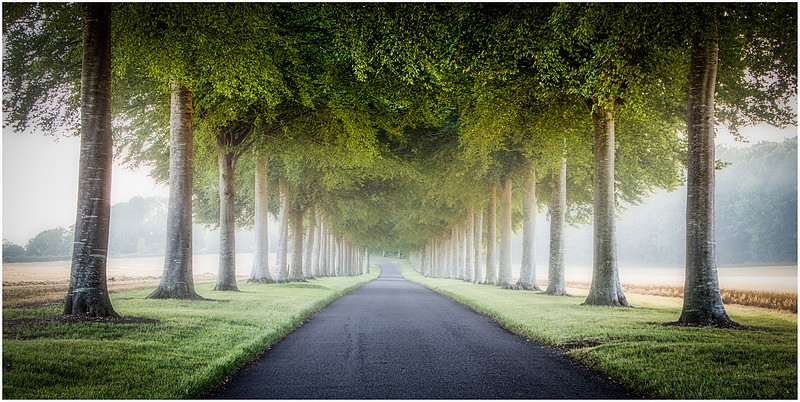
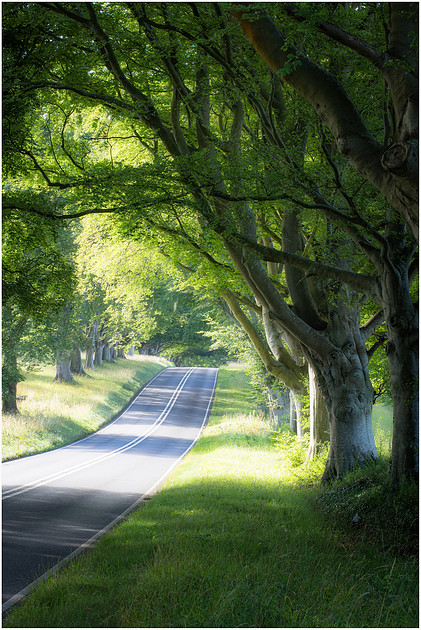
Moor Crichel, like Sixpenny Handley is a small village nestling in the classic English countryside within Cranborne Chase. Crichel House stands proudly within the Crichel Estate overlooking the ornamental gardens and lake. The original Tudor house, owned by the Napier family, was largely destroyed in an accidental fire in 1742 and was rebuilt by ‘John Bastard of Blandford’. I like that name, and it seems accidental fires were all the rage back then. Humphrey Sturt, of Horton, in Dorset, acquired the estate in 1765 and extensively remodelled the house. The ‘remodelling’ involved moving the entire village of Moor Crichel a mile to the south so he could create a new lake in the grounds of the house. The whole village was completely sunk beneath the lake, thankfully he did stop short of moving St Mary's Church, which remains today. Back to my reason for being here and my journey to Moor Crichel would take me along a beech tree lined avenue. A long, straight well-kept narrow lane of beech trees should make a great image in the mist. I drove along the avenue before parking up and turning to look back to where I had entered the village.
Beech tree lined avenue at Moor Crichel
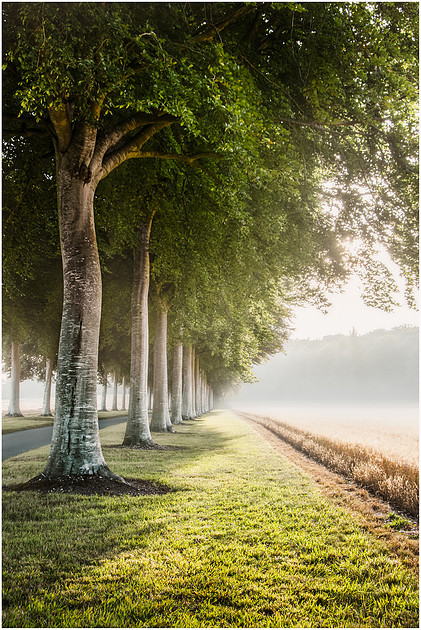
The mist was rolling in and out and, in this image the direct sun was very much diffused in the fog. Standing here fiddling with a lens that was refusing to focus was a bit of a faff as it wasn’t exactly an empty road despite it being a little before six in the morning. I managed not to get run over and as the sun started to appear through the mist, I moved myself over to the grass verge for a portrait shot.
The avenue
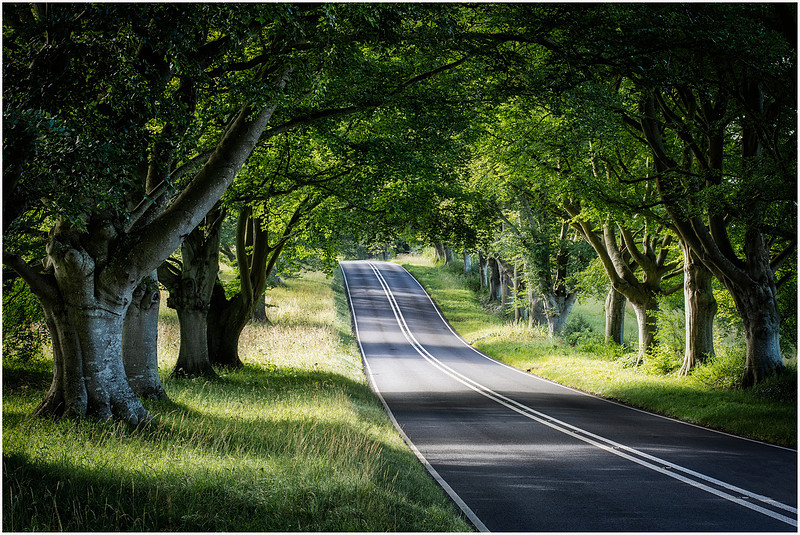
What a great place to drive through on my journey to the Dorset coast. I didn’t have time to drop by the Estate, but here is a little historical fact about it. Crichel Estate was the home of Princess Charlotte (Granddaughter of Mad King George). She was heir to the throne and destined to become Queen of England. But she had a disagreement with her father about a marriage proposal, so he banished her into isolation at the estate. Charlotte did happily marry, but died in 1817, aged just 21. Because of her untimely death, the next in line to the throne would eventually become Queen Victoria some 30 years later! Just outside of Moor Crichel lies the entrance to an ancient Roman road known as Ackling Dyke. An impressive structure running 22 miles from Old Sarum in Salisbury, to the Iron Age hill fort at Badbury Rings, which was to be my next destination. Built so well to move troops across the country, much of the Roman road is still visible today through agricultural land. Time was not on my side, so attempting the long hike through the fields was not my plan, opting for the 17 minute zip in Mr T. The rings were not my primary destination, more a place for something to eat and park before heading on foot down the Blandford Road. Another avenue of beech trees, however these specimens are over 200 years old and form a shady canopy right across this much wider and undulating road.
Shady Blandford Road
According to Dorset Life: “Born in 1776, William John Bankes was, as a young man, an aide-de-camp to the Duke of Wellington and became an active Member of Parliament. In 1835 he inherited Kingston Lacy. A good friend of Lord Byron from Cambridge days, he enjoyed liaisons with men and women indiscriminately and in 1841 he had to go into exile after being caught with a guardsman in St James’s Park. While in residence at Kingston Lacy, William John made many changes, including the installation of the Egyptian obelisk that may be seen in the gardens to this day. One of the first things he did was to plant a beech avenue lining the road from near the house’s entrance drive to beyond Badbury Rings. The road was a turnpike, and the Bankes family enjoyed the revenue from it. The avenue was a birthday gift to William John’s mother, Frances, and there were 365 trees on one side of the road for each day of the year and 366 on the other, for a leap year.” No standing in the middle of the road here to get the best shots.
Mother’s trees
This morning had been a great start to a trip to Dorset, and to be quite honest one of the most memorable. As I write this narrative some two years later, I still count it as the most spell binding ninety minutes standing on the edge of the field of wheat at Sixpenny Handley watching the stag wander through the crops as the sun rose and turned the mist to gold. But now it was time to find my campsite and catch up on some sleep having been awake for a good 28 hours by now. The weather forecast for the week was looking good and I had plans to walk the Jurassic Coast around Durdle Door, climb Combers Hill, walk to Old Harry Rocks and catch a glimpse of Comet NEOWISE along with some Milky Way photography during the upcoming new moon phase.
I’m going to need my sleep.
Keywords:
Barn,
Beech Trees,
Blandford Rings,
Blanford Forum,
Cranborne Chase,
Dutch Barn,
Landscape Photography,
Mist,
Moor Crichel,
Sixpenny Handley,
Sunrise,
Wheat

Comments
No comments posted.
Loading...
|