Autumn adventure in Scotland, UK. (Part I)Into the coppery halls of beech and intricate oak to be close to the trees as they whisper together let fall their leaves, and we die for the winter (Whim Wood - Katherine Towers). The trample of robins and woodlarks on the brown leaves. and the patter of squirrels on the green moss, The fall of an acorn on the ground, the pattering of nuts on the hazel branches as they fall from ripeness (Pleasant Sounds - John Clare).
Autumn, my most favourite time of year, when I wait each morning to see how the colours have changed and if the mists have formed. When Max and I, torch in hand, now make the morning walk briskly kicking leaves trying to avoid a daily soaking. With both fine weather and storms forecast, the time had come for my annual autumn trip, and this year I was blessed with another visit to Scotland. I had a planned itinerary, but with the freedom of flexible time, I knew it could be easily changed or dumped as and when the weather came through. According to the forecast I could expect just about everything, so we packed up the van with all the right clothing, footwear and towels for Max and hit the road.
Ready for the off (all important bone)
As a warm up, and also to break up the long journey to Scotland’s north east coast, we headed straight for Bamburgh Castle. I have a favourite spot where we stop for a few hours rest, right on the beach. So, Day 1 would be all about driving and getting closer to Scotland. Bamburgh beach is one of my favourites, with long flat sands, glorious sunrises and a great atmosphere when stormy. I took one of my favourite pictures there last year.
Stormy Bamburgh
The forecast tomorrow was for a brief dry window just before sunrise, but as ever it can be very changeable on the north east coast of England and I wasn’t expecting it to last for long before the front came over. So, I enjoyed a relaxing evening all toasty in the van with a book, listening to the waves crash below me on the beach before setting my alarm for nice and early. I’m currently reading the DI Nick Dixon Crime Series if anyone is interested. Highly recommended.
Day 2
“I eagerly bounced my ample backside over the lumps and bumps “
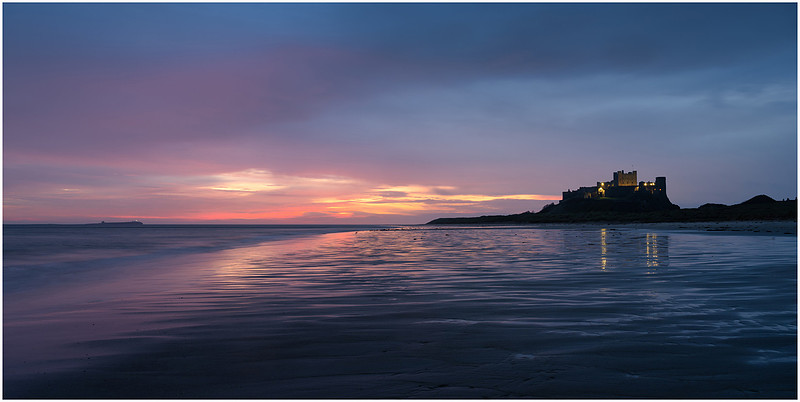
The morning came and Max and I headed out for a walk along the beach after having something to eat. It was still headtorch time, but Max managed to have a good run as the tide began to turn, finding a few decent washed up logs to chew on. As forecast, just minutes before sunrise the heavens opened and chased us back off the beach and into the safety of the dry van. But not before I had planted myself on the shore and grabbed one image. I used my wide-angle lens to include the lighthouse on the Inner Farne Islands. Something I normally exclude here, but given it was still dark, the flash from the lighthouse added an additional element to the picture.
Before light at Bamburgh Castle
Nothing complex here for this shot, apart from keeping the tripod just above the point where the waves were washing in. 24mm focal length, aperture at f/8 and a 6 second exposure. I did pop the ISO up a little to 100 as it was so dark. Dried off, my next location was to be Canty Bay, north of Dunbar on the way up to Edinburgh. But after an hour on the road, it was clear this heavy rain was set in for the day and getting heavier. Breakfast in the services, and I poured over the maps and weather forecasts and opted to spend the wet day driving and keep heading north another 230 miles further to a familiar location at Rattray Head. The forecast for the next morning was looking good and there was a great isolated spot next to the beach where I could camp out for 24 hours. After all, as much I do like sunrise to sunset photography, chilling out on location is also a must and something I always add into my itinerary where possible. Those of you familiar with some of my previous trips will know Rattray Head is where I lost a very expensive lens to the elements during a brutal storm a few years ago. Gale force winds, horizontal airborne sand and cameras don’t always mix well. I did manage a few images in that visit but the damage to the lens rendered them average at best.
Rattray Head 2019
A lump of washed up rope and shaky blurry lighthouse is not what I came all this way for. I wanted to try again. - - - - - - - - The road to Rattray Head is a long, narrow affair once you leave the main roads. You need to take your time dodging van-swallowing potholes and ditches praying nothing is coming the other way as there are no passing places, just a very long reverse for the unlucky party. It was becoming clear I was in for a great sunset despite the gloomy forecast, so I eagerly bounced my ample backside over the lumps and bumps. After 200+ miles of travelling, Max was busting to get out and “stretch his legs”, so as soon as we got to the small car park he was released and made straight for the sand and a swim.
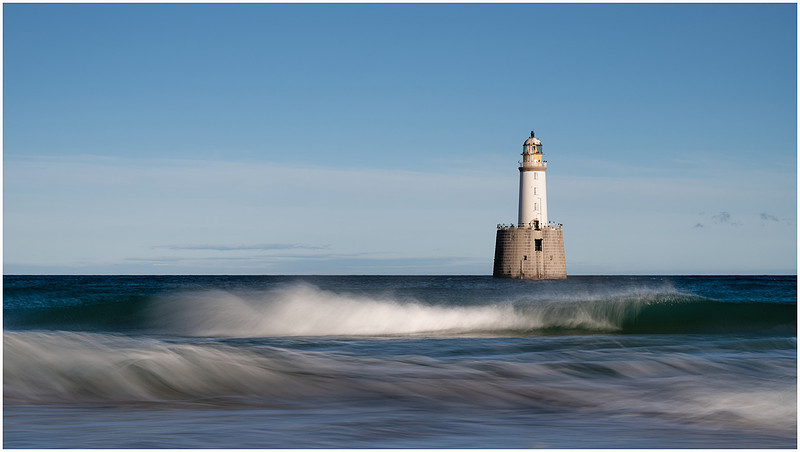
The beach at Rattray Head juts out into the North Sea and catches the prevailing winds coming in from the sea. This means high sand dunes, an ever-changing landscape and plenty of washed-up debris. Its location at the end of a tricky narrow road means you are likely to be the only person there for most of your visit, as was the case for me again. After Max had his swim and dived around the sand dunes to dry off, it was time to get down to business as the sun began to sink behind me. I had arrived at high tide so was excited to get some great shots of waves crashing on the beach with the lighthouse in the background. What would I find washed up on the beach? I wanted to slow down things a little and capture some movement in the waves, so dropped in my 3 stop NDF filter over the top of my polariser. With the afternoon light, this allowed a 1 second exposure at f/11, perfect to show movement in the waves and keep most of the image in focus.
Standing room only
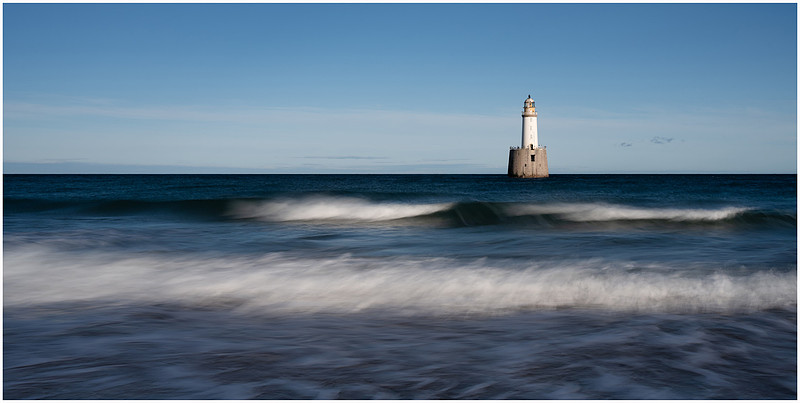
The lighthouse is just away from the beach, so is a popular spot for cormorants to sit and dry off their feathers after a fishing trip. I dropped my tripod down lower and zoomed out a little to capture some of the wash coming up the beach.
Incoming wash
The whole time I was taking these shots we were eagerly watched by a seal offshore. A head would pop up for a few seconds, have a good look and then disappear. Max didn’t notice, even when he went in for a swim. According to the Northern Lighthouse Board:
“Rattray Head lighthouse was built in 1895 and engineered by David Alan Stevenson. Work began in 1892, and the masonry of both portions of the tower was completed in 16 months, spread over three seasons. The lower section, 20,000 cubic feet of dressed granite blocks mostly quarried at Rubislaw, was 46 feet high, with an entrance door reached by a 32 foot outside ladder, at high water it is covered to a depth of 7 feet but it is possible to walk ashore when the tide is out, the upper, with a case diameter of 21 feet for the lightroom, lantern and dome brings it to a total height of 120 feet above the rock. During the Second World War on 20 September 1941, an enemy plane circled the lighthouse and dropped three bombs, one of which did not explode. The lantern was machine-gunned but the damaged caused did not seriously impair the efficiency of the apparatus. No one was injured in the attack.”
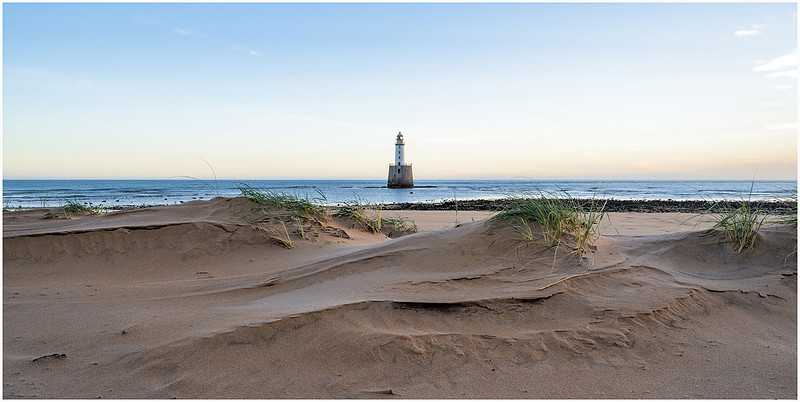
Because of Rattray’s location on the east coast and the height of the sand dunes on the beach, it isn’t ideal for a sunset shoot as the lighthouse is cast in shadow well before the sun sets. That said, with the right cloud formation, some great sunset colour is possible. Today however, the clouds had all but cleared off, so I set about trying to get a reflection in the wet sand as the tide was retreating. Just after 3pm the sun was now low enough to be reflected in the windows of the lighthouse and the harsh bright light had been replaced with a soft pink across the whitewashed walls of the lighthouse.
Sunset pinks
Slightly longer exposure of 2 seconds here to capture the withdrawing waves on the sand and aperture at f/11 to stretch the depth of field. Definitely a bonus afternoon, as I had expected it to be still raining until darkness. Time to get comfy for the night and put some tea on. The sun was set to rise again at 07:20 and the forecast was still looking great. The tide would be at its lowest during sunrise, so the scene was going to be very different from this afternoon and I could look to see what had been washed up overnight. Classic hippy behaviour.
Day 3
The rattling alarm in the van, Max bouncing up on the end of the bed and me trying to find my glasses would become a daily routine, and this morning was a reminder of what these autumn sunrise to sunset days away are like. Of course, I wouldn’t change a thing because there is nothing better than putting the kettle on, opening the blind and seeing what your morning view is like. All without even getting out of my warm bed. My view this morning was the outline of the sand dunes and a faint warm orange glow in the distance broken intermittently by the flash of the lighthouse. I had positioned my van so that I could still see the lighthouse and had enjoyed its comforting regular flash of light during a very dark night. We hit the beach 30 minutes before sunrise, and I was amazed to see all my footprints from yesterday had either been erased or blurred out by the moving sands blown across the beach. I whipped out my phone and grabbed a few shots before heading off to the shoreline.
The tide had turned, and was on its way back in leaving very squishy sand and lots of nice pools, so Max and I wandered around looking for some foreground composition. Of course, doing this with a Labrador who likes nothing more than an empty beach to run around and search for anything edible, will always be a challenge. Most dogs, as soon as you let them off the lead on a beach they run around like a crazy wild horse and Max is no different apart from he instinctively knows where the best compositions are and runs through them leaving his mark before you can so much as take your lens cap off.
Fresh paw prints in my shot
Despite Max’s best efforts to trash my composition, I managed to keep this one clear long enough for the sun to rise.
Sunrise reflections in the pools
I waited patiently for this little cloud to move along and be reflected in the pool, whilst keeping Max sat still behind me.
Why the long face? Seaweed selection
Both these images are three-shot, bracketed, focus-stacked images.
The same result can be obtained by closing down the aperture to give a greater depth of field and dropping in a graduated filter for the sky. However, in this particular composition the lighthouse is sitting on the horizon so a graduated filter would have presented some challenges. Choose either method dependent upon your composition and the light. Read on and you will see the alternative method deployed in a rapidly changing scene. The sun was struggling to get through a bank of cloud on the horizon, so whilst I was getting a great sunrise glow, there was very little direct light on the lighthouse. Max had been wandering off earlier and found a bunch of washed up logs and sticks he could chew and nearby I could see what looked like a tree stump, so headed over to investigate. Keeping Max in check and doing a wide sweep to avoid my own footprints polluting the scene, I found a lovely grained washed-up tree stump. The sun obliged and came out washing the bleached grain and twisted roots with warm orange light.
Washed up
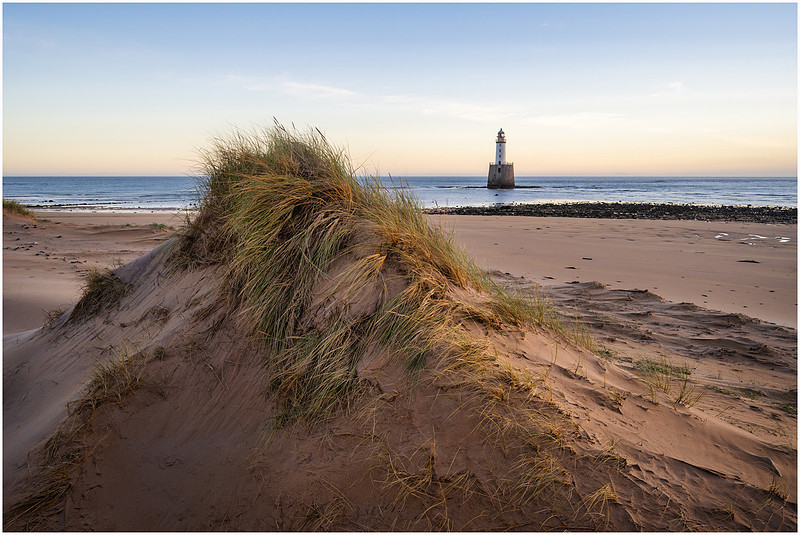
It was time to start making a move back to the van as I had another day of driving ahead of me. I stopped off at the dunes and grabbed my last couple of images of Rattray Head Lighthouse. I imagine it will be some time before I return again.
Golden sands
Windswept
Fairwell Rattray, it has been a much more successful visit. Until next time.
“He sat his ample backside on my tripod leg”
The previous evening, I had made the decision to totally ditch my itinerary and head further north before hanging a left and making my way inland to the Cairngorm mountains. From there I could decide if I should return via the west or east coast weather depending. So, my next stop was a short one-hour drive away at Portknockie. I was retracing a coastal route I took in February 2019 to reach Durness, and could not resist a quick stopover at Bow Fiddle Rock where, whilst managing to go apex over elbow running down to the beach, I had grabbed one of my favourite images to date.
Bow Fiddle Rock 2019
After a bit of lunch, we headed down to the beach before high tide. I spent a while setting up a very similar shot, but the wash of the waves was quite weak and the results were not best. I needed to wait for the tide to come in further. Max can sometimes get quite bored if I start faffin around “waiting for the light” and sure enough in the middle of taking a series of stacked images, he sat his ample backside on my tripod leg and trashed my composition. Revenge for bouncing him down the lane to Rattray?
Keeping Max entertained.
The light was coming and going, and I did have to get moving to make my next stop before dark, so I decided to take my last portrait image and go find an alternative angle closer to the sea, and further away from Max’s fat rear end.
Bow Fiddle Rock 2022
I moved over to the right of the beach and went for a landscape image.
Trying a new composition
Edging closer to the waterline, I dropped my tripod into the calm water. With the wind blowing the clouds away from me I dropped in another NDF filter and went for a two-minute exposure.
The Return
The previous phone image was taken whilst the two-minute exposure was under way, and you can see how the cloud line has moved away from me and given a great feeling of depth to the image. Lifting the shadows and desaturating the blues gave a more pastel turquoise-blue feel to the picture. I was well chuffed with the outcome of my second visit to Portknockie, and this new capture reminds me of some of the surrealist painting I did as a teenager. This visit also reminded me not to become obsessed with one angle, but to walk around each location with camera in hand. Try out all possible angles, or even just take lots of phone pictures to see how they look. Instead, I had sat for over an hour waiting for the tide on a specific angle only for Max to trash my shot as he got bored. So next time, move around more before gluing myself to my tripod, and keep Max entertained. Time to head off inland with Loch Garten being my next destination.
“The stamping of heavy footwear grew louder”
The change in scenery was marked as I turned inland picking up the A95 at Keith. From here on I would follow the path of the River Spey from ‘Boat o’ Brig’ to ‘Boat of Garten’ before settling down for the night hidden in the middle of the Abernethy Forest surrounding Loch Garten. From sparse windblown coastal routes and beaches, I was soon bumbling through the lush golds and browns of autumn colours. The setting sun casting long beams of light through dense tree lined roads, twisting and turning through small crofts and villages as we made our way up and along the course of the River Spey towards the Cairngorms. At around 100 miles long, the River Spey is the eighth longest river in the United Kingdom, as well as the second longest and fastest-flowing river in Scotland, running more or less from Fort Augustus (where I would be spending a night sheltering from yet another autumn storm in a few day’s time) before entering the sea 5 miles west of Buckie. Shortly after passing the Tormore Distillery, I entered the Cairngorms National Park and began my ascent through Speybridge and on toward Aviemore. The call of nature was kicking in, so before I turned onto the narrow forest roads, I pulled into the visitor centre at Nethy Bridge for a ‘wash and brush up’. “Busy car park” I thought as I squeezed Mr T into the only remaining slot. Clutching my toilet bag and sporting 2 days of bed/hat hair and stubble I walked into the community hall only to be met with the sound of live music and laughter. The stamping of heavy footwear grew louder and the inner door burst open as several small children clad in kilt and sporran screamed their way past me wide eyed with remnants of cake stuck to rosy-red faces. “Wedding?”. Through the open door I was privileged to witness a traditional cèilidh with the bride and groom clearly getting stuck into the dancing. Thankfully no-one noticed the scruffy Englishman standing at the door, so whilst the heavy footwear continued to grind down the floorboards, I quietly made my way to the toilets for my ‘wash and brush up’. What a great surprise and a thing to behold. Time to make my exit. The last 4 miles from Nethy Bridge to Loch Garten take you through single track, tree lined, roads.
The road to Loch Garten
As I drove along, the low light was breaking through the dense forest now and then lighting up small Silver Birch trees whose leaves were the brightest golden yellow. I parked just off the main road in a designated spot where it is permitted to stay overnight. Just time for a short walk before dark to get my bearings and for Max to ‘stretch his legs’, so I grabbed my camera and headed towards one of the small golden trees I had spotted.
The jewel in the forest
Being accustomed to getting lost in a forest (long story) I could see that wandering from any sort of path was not a good idea. Neither was leaving a trail of breadcrumbs when you have hungry Max with you. It was getting darker, so I retraced my steps, and we headed back to the van before the light went all together.
My view for the night
It was soon dark, and I enjoyed eating my tea outside the van watching the stars twinkling through the canopy of the forest. To say it was quite spooky surrounded by such dense forest is an understatement in the extreme. I woke a few times convinced I could hear rustling in the trees. Maybe I did? Long day.
Day 4
Today was to be a forest exploration around the loch. I have been here a few times before now, but never really ventured that far. So, time to put that right and get out there for a full day’s exploration, as I planned to stay here for a second night. I might come to regret that decision.
“I thought I had stumbled upon a ritual murder scene”
The Loch Garten nature reserve is managed by the RSPB and is home to Golden Eye, Capercaillie and, amongst other birdlife, Osprey who can be seen fishing in the loch and River Spey. According to the RSPB website:
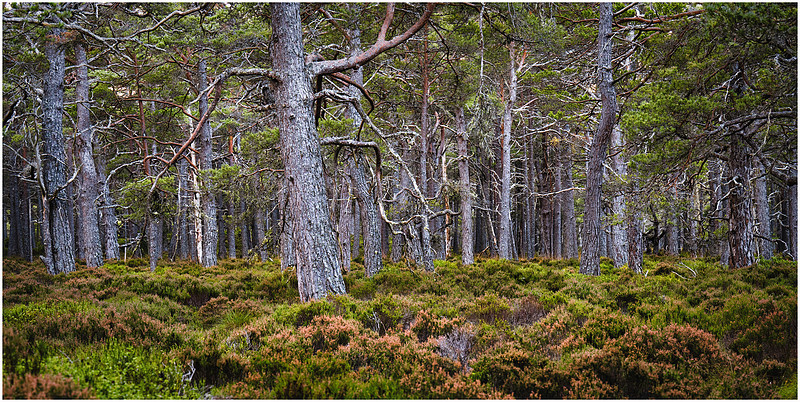
“The wildlife-rich Caledonian pineforest is like no other forest in the UK. Huge, gnarled, lichen-encrusted Scots pine trees dot the landscape, interspersed with other species such as juniper, rowan, birch, blae’berry and heather. Pinewood specialities like twinflower and creeping ladies tresses are to be found, nestling in the lush vegetation. A myriad of fungi helps to break down the deadwood, a vital component of a healthy forest. The heather between the trees continues through the forest edge, to form stretches of moorland. In August, the hillsides erupt in a riot of fragrant purple heather, attracting nectar-seeking invertebrates. Rich, peaty-brown water flows in the rivers and fills the lochs. Brightly coloured sphagnum mosses act like sponges and store water, creating invertebrate-rich, boggy areas. Scots pine trees grow pale and stunted in bog woodland, a rare habitat with specialist species. Formed by volcanic activity and shaped by glaciers, the sub-Arctic plateau of the Cairngorm Mountains is unique in the UK. Rare, fragile plant and lichen communities survive the sub-zero temperatures and hundred-mile-an-hour winds in the winter, alongside hardy ptarmigan. As well as Ben Macdui (1,309m), Abernethy holds several other peaks, including Cairngorm (1,245m), Bynack More (1,090m) and Meal a’ Bhuachaille (810m)”.
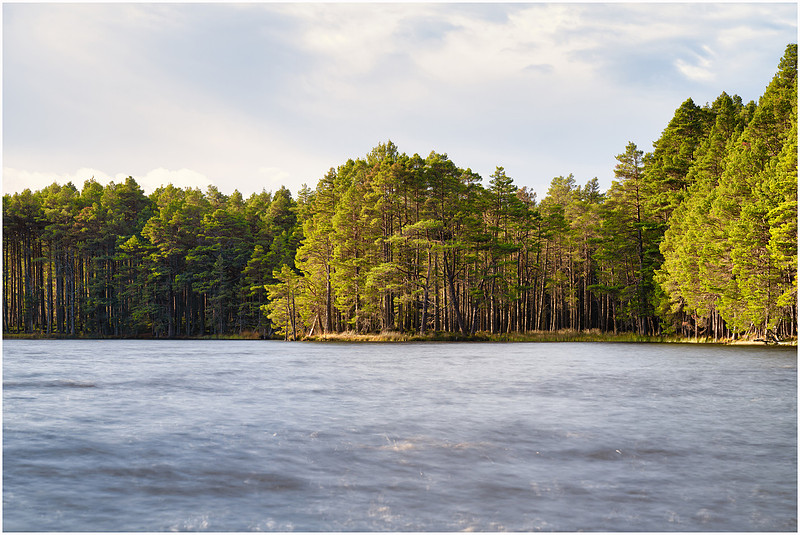
My first destination of the day was the far side of the loch, and I would get there by hugging the shoreline, grabbing images as I went along. From the van I followed the path along the edge of the loch, dipping in and out of the tree line. One of those “sunshine and showers” days when the low autumn sun shone threw it would light up the darker parts of the forest showing you the golden birches hidden within. I was aiming for a small area I could see from where I had parked that appeared to have a small beach. Movement in the trees up ahead. Clothing scattered across the shoreline and much screaming from the loch. I thought I had stumbled upon a ritual murder scene rather than a gathering of ladies taking a wild swim in the loch. Wild swimming seems like a good idea, but judging by the amount of screaming these ladies were doing as they waded into the loch, maybe it’s a pastime for summer only? The one and only male had the right idea staying on the shore and filming their pain. Smart thinking. The light was catching the trees across the loch so time for some photography whilst Max chewed on a few sticks. For my first shot I wanted to remove some of the distraction in the dark choppy water so dropped in my circular polarising filter to maximise the reflections and a 6 stop NDF to give me a total of 2.5 seconds at f/8. Just enough to smooth the water out a little but not too much movement in the trees. I got the camera low down to the water’s edge and waited for the wind to die down for a few seconds.
Loch Garten Autumn colours
I love how the low light is penetrating the tree line lighting up the trunks of the densely packed trees. When standing on the edge of the loch the ground beneath you is quite springy, almost like a trampoline. I found a spot where the water had eroded the bank and you could see that what you were standing on was not solid ground, but a network of tree roots forming a platform out over the water.
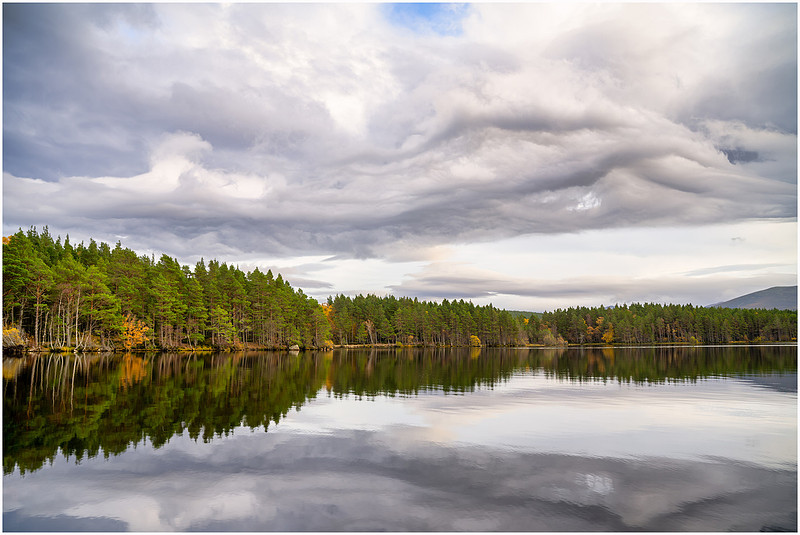
At some spots you could see water beneath your feet some distance from the visible waterline. I left the wild swimmers to their wild “fun” and Max and I moved off along the shoreline heading for the trees I had just captured in my first image of the day. The only sound as I made my way along the shore was the lapping of the water on the shore, the wind in the trees and the frequent sound of snapping twigs under my size 11’s. I’d never be any good in the SAS. It was a lovely morning, and I enjoyed walking quite some distance around the loch moving in and out of small bays and alongside boggy reed beds making sure we did not disturb any wildlife. The wind had dropped, and the forest fallen almost silent. Looking through the trees I could see the clouds were forming some very strange shapes, so I headed to the shore and pointed my camera back across the loch.
Cloud formations over Loch Garten
My basic meteorological skills cannot fully explain this phenomenon, but for a period of around 30 minutes, the wind at water level dropped completely turning the loch into a mirror as strange twisting clouds moved across from the direction of the Cairngorm mountains. With the presence of some lenticular clouds in the distance, I could only assume this was the movement of a front across the mountains. Pretty soon after this image was taken, the wind picked up again and the loch returned to being a choppy mess. At this point the path turns inland away from the protected areas of the shore around Loch Garten and the nearby Loch Mallachie. Here there are nesting boxes for the tree-nesting Goldeneye ducks. The Goldeneye is listed as an endangered species and the RSPB do great work here to help protect them. Time for me and Max to explore inland. We followed a narrow twisting curved path that slowly took us back around the loch. Dipping in and out of the treeline we found many patches of gold hiding in the depths of the forest.
Golden treasure
Playing hide and seek
Lighting the way
Eventually I could see the loch again appearing through the dense forest and we headed back toward the water.
Heading back toward the loch
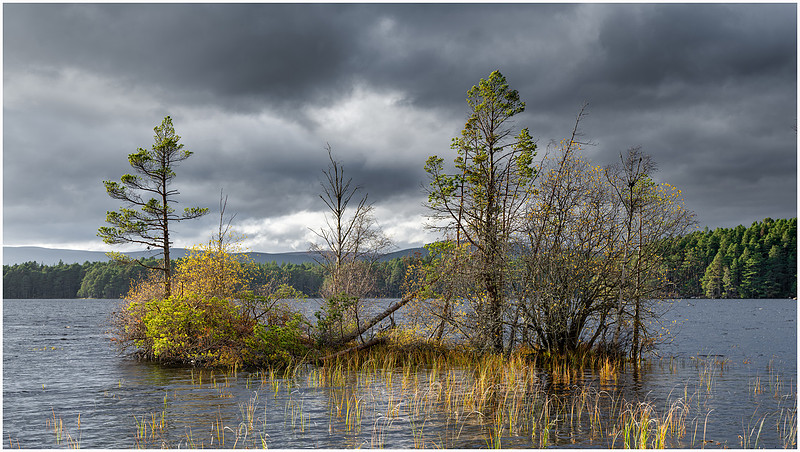
As we emerged from the forest once again, I found this small island just offshore. The sun was getting lower and casting a lovely golden colour on the reeds.
Afternoon sun
What a great day’s walk around Loch Garten. Woodland photography is not easy, and not something I normally do, but the Abernethy Forest delivers a plethora of photographic opportunities even for a relative woodland novice like me. I highly recommend a visit along with a stop at the visitor centre where you can hand feed birds, who have become so accustomed to humans they will land on your hand for a treat. Donna and I were here a few years ago when staying at Boat of Garten and paid the birdies a visit.
Visiting the birdies
Time to head off back to the van and spend the afternoon processing images from the last few days. Tomorrow we head off on the second part of our Autumn adventure round Scotland.
Join me in Part II as Max and I head off from the Cairngorms and plot a course to the North West Coast of Scotland, drive for miles down single track roads, stay over at deserted white sand beaches, stand in awe of the majestic Assynt Mountain range and come unstuck with a group of German tourists.
Keywords:
Abernethy National Nature Reserve,
Bow Fiddle Rock,
Landscape Photography,
Loch Garten,
mountains,
Portknockie,
Rattray Head,
Scotland,
sunrise,
sunset
&layout=none&ref=https://www.christophernicholls.co.uk/blog/2022/11/autumn-adventure-in-scotland-uk-part-i)
Comments
Lyn(non-registered)
WOW You and Max certainly had Amazing Aventures and the Story as well as Spectacular Photographs are proof that You Did. Happy Amazing Photographic Adventuresfor the rest of your Travels.
Andrew(non-registered)
Lovely read as I head back from Edinburgh to Slaithwaite - enjoy your trip!
No comments posted.
Loading...
|